


New initiative to train frontline humanitarian workers in MENA launched at One Health Summit; first campus planned for Gaza
The Mérieux Foundation, Community Jameel and Bioforce today signed a memorandum of understanding to explore establishing the Bioforce MENA Mérieux-Jameel Hub, a regional centre to strengthen humanitarian and health workforce capacity across the Middle East and North Africa (MENA). Training 1,300 humanitarian and health professionals by 2030 in its first phase, and aligned with the ‘training ending with employment’ approach, the hub’s first campus, to be initially based in Egypt, seeks to focus on the emergency response in Gaza.
The signing was announced in Lyon, France, during the One Health Summit, a high-level international gathering convened by French President Emmanuel Macron.
There is an acute and urgent need for trained humanitarians in MENA at a time of regional conflict. According to the United Nations (UN) Office for the Coordination of Humanitarian Affairs (OCHA), over 588 humanitarian aid workers have been killed in Gaza since October 2023,1 and over 280 paramedics and health workers have been killed in Lebanon during the major escalations in 2024 and 2026. Severe cuts to overseas aid funding have dismantled capacity, including training, in frontline agencies of the UN and other humanitarian actors.
At the same time, the need for aid in MENA has risen dramatically. At the start of 2026, the region already accounted for 24% of global humanitarian need, with over 58 million people requiring urgent assistance (UN OCHA, 2026). These figures predate the recent escalation of hostilities in March 2026, which has further worsened the humanitarian situation. In Lebanon alone, over 1.2 million people have been newly displaced, creating an immediate emergency far beyond the initial projections for the year.
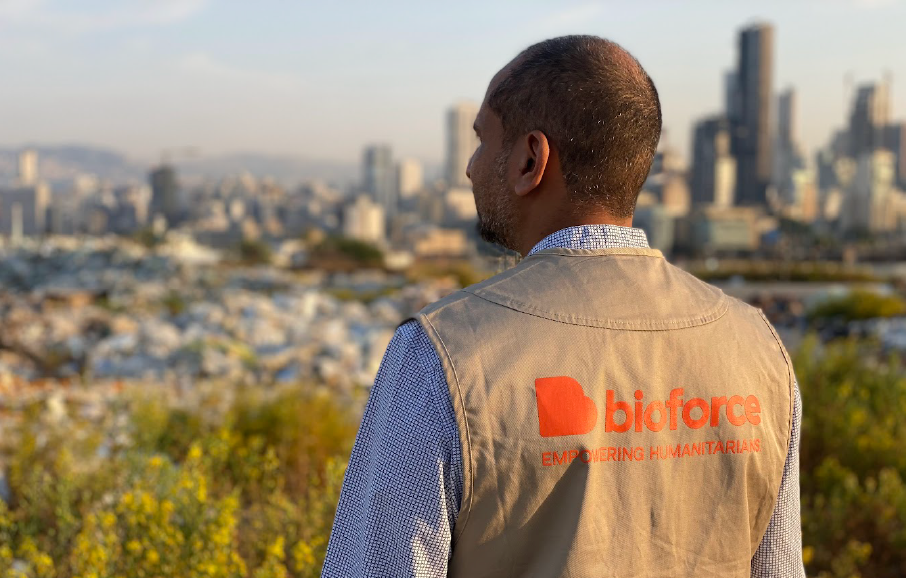
A global leader in training provision to the international humanitarian community for more than 40 years, Bioforce stands to lead the Mérieux-Jameel Hub, with intended joint support from the Mérieux Foundation, an independent foundation created in 1967 specialised in fighting infectious diseases in resource-limited countries, and Community Jameel, a non-profit organisation advancing science and learning for communities to thrive.
Operating from Beirut, Lebanon, and with a Gaza campus initially operational in Egypt, the hub aims to collaborate with a growing network of universities, training institutions, and humanitarian organisations across Egypt, Iraq, Jordan, Syria and Yemen.
Combining in-person, digital, and intensive, short-term campus models, the Mérieux-Jameel Hub seeks to offer both short and long courses leading to accredited certification.
Dorothee Lintner, Director General of Fondation Mérieux, said: “The creation of the Bioforce-MENA Mérieux-Jameel Hub marks a decisive step in Mérieux Foundation’s long-standing commitment to the Middle East and North Africa. By uniting our expertise in infectious diseases with the strategic strengths of Community Jameel and Bioforce, we are building a sustainable regional anchor for health resilience. Announcing this partnership at the One Health Summit underscores its vital importance within the global health agenda. In these times of unprecedented crisis, strengthening the capacity of frontline humanitarian workers is not just a necessity; it is a moral imperative to ensure that local expertise leads the response and protects the most vulnerable communities.”
George Richards, Director of Community Jameel, said: “With more than 1,000 health and aid workers killed in conflicts in Gaza, Lebanon and Sudan in the last three years, together with cuts to overseas aid budgets and the displacement of millions of people in the MENA region, there is a huge demand for humanitarian relief across the MENA region. The Mérieux-Jameel Hub, with its first campus focused on Gaza in Egypt, aims to respond directly to this urgent need, delivering technical training to 1,300 humanitarian professionals by 2030 to fill vitally important roles on the frontline response.”
Florence Villedey, Director General of Bioforce, said: “Humanitarian needs across the MENA region are increasing while the pathways for professional accreditation are shrinking. This Hub is a direct investment in the region’s human capital. By working with a broad spectrum of partners, from local NGOs to major universities, we ensure that those closest to the crisis have the training and authority to act effectively.”
The Bioforce MENA Mérieux‑Jameel Hub seeks to build on Community Jameel’s ongoing support to strengthen humanitarian action and the effectiveness of emergency response during crises. Since 2023, in response to the emergency in Gaza, Community Jameel has supported Save the Children, Imperial College London and the Egyptian Ambulance Authority to deliver care to blast-injured children, newborn babies, including pre-term babies, pregnant women and new mothers evacuated for urgent medical attention from Gaza to Egypt.
Community Jameel has also partnered with the Jameel Institute at Imperial College London and the London School of Hygiene and Tropical Medicine, to launch the Jameel Institute Realtime Intelligent Support for Emergencies (RISE). The platform delivers real-time data and predictive modeling on injuries, malnutrition, mortality and vaccination planning to guide humanitarian responses in conflict-affected settings, such as Gaza and Sudan. The Jameel Institute-RISE is currently supporting the World Health Organisation in developing joint World Bank, EU and UN interim rapid damage and needs assessments for Gaza to address chronic and infectious disease needs.
About Community Jameel
Community Jameel advances science and learning for communities to thrive. An independent, global organisation, Community Jameel was launched in 2003 to continue the tradition of philanthropy and community service established by the Jameel family of Saudi Arabia in 1945. Community Jameel supports scientists, humanitarians, technologists and creatives to understand and address pressing human challenges in areas such as climate change, health and education.
The work enabled and supported by Community Jameel has led to significant breakthroughs and achievements, including the MIT Jameel Clinic’s discovery of the new antibiotics halicin and abaucin, critical modelling of the spread of COVID-19 conducted by the Jameel Institute at Imperial College London, and a Nobel Prize-winning experimental approach to alleviating global poverty championed by the co-founders of the Abdul Latif Jameel Poverty Action Lab at MIT.
About the Mérieux Foundation
Created in 1967, the Mérieux Foundation is an independent foundation with public interest status committed to fighting, in the field, the infectious diseases that affect low-income countries. It works independently in the service of global health. By adopting a “One Health” approach, it contributes to achieving several of the United Nations’ Sustainable Development Goals.
The Mérieux Foundation works side-by-side with local and international partners to build capacities, particularly in clinical laboratories, to improve healthcare, surveillance, alert and response to epidemics. Taking a global health approach, the foundation also aims to improve living conditions for the most vulnerable populations.
About Bioforce
For over 40 years, Bioforce has been a key player in the professionalisation of humanitarian response across Europe, Africa and the Indian Ocean. It strengthens both individual competencies and organisational capacity to enable effective responses to conflicts, disasters and epidemics. Bioforce delivers robust, field-oriented training programmes designed for real-world operational challenges. It also supports local civil society organisations, working closest to vulnerable populations. Through its approach, Bioforce promotes professional, efficient and accountable humanitarian action, improving impact where it matters most.